
Towns and Villages
Local Villages
Camber – coastal village with Camber Sands, famous golden sandy beach and dunes — great for walks, kite flying and relaxed beach vibes.
Iden – small traditional village 3 miles north of Rye with a medieval church, village shop and local pub — peaceful countryside setting.
Udimore – rural village with walking paths and a popular local pub (The Kings Head) about 5 miles from Rye.
Brede – larger village with a village shop, butcher, good pub (The Rainbow Trout) and beautiful woodland nearby (Brede High Woods).7–8 miles west; bigger village with countryside views – great for photos and pub stops.
Beckley – pretty Sussex village with local community atmosphere and lovely countryside. 5–6 miles northwest; typical Sussex village, good for a longer cycle
Playden – very quiet rural village with historic church and two well-liked pub-restaurants. Easy countryside stroll with lanes and field paths. About 2 miles
Peasmarsh – charming village on rolling hills with shops and pubs — a good base for exploring vineyards and walks. Rye → Peasmarsh Walk (~4 miles) – Mostly level and scenic lanes.
Tillingham – Natural Wine with a View - Just a short drive from Rye, Tillingham Winery sits on a 70-acre hilltop estate with sweeping views over the Sussex Weald. It’s a working biodynamic vineyard and farmstead, blending rustic charm with clean, modern design. Guests can enjoy natural wines made on-site, explore the cellar, or settle in for a long lunch in the restaurant – where everything is rooted in sustainability and flavour. There’s also a relaxed bar, pizza in the courtyard, and rooms if you feel like staying longer. For more information about Vineries visit https://stayinrye.com/en/vineyards
Icklesham / Guestling –3-5 miles northeast/north; lovely classic rural villages, especially picturesque from bike. Classic English countryside village with historic church, rolling landscapes and cosy pubs. St. Nicholas Church – a picturesque medieval church and The Queens Head (highly rated for food and drinks). About 3 miles (5 km) from Rye. By bike: ~15–20 minutes, mostly flat countryside routes. on foot: ~1 hour, scenic rural paths. Small shops and community hubs.
Winchelsea – iconic medieval town with grid-patterned streets, medieval church, museum, old gates, and nearby Winchelsea Beach. A peaceful, picturesque character – often described as one of England’s smallest towns, with lovely views over the Romney Marsh and towards the sea. Nearby Winchelsea Beach, quieter than Camber Sands and loved for walks and birdwatching but its a shingle beach. Distance: about 2–3 miles (3–4 km), Bus: about 10 minutes on routes heading toward Hastings, Walking: roughly 45–60 minutes, mostly flat with lovely countryside views. Impressive medieval remains, including: Town gates (Strand Gate, New Gate & Land Gate remnants), St Thomas the Martyr Church, part-ruined but beautiful and historically significant. Extensive medieval wine cellars beneath the town – a reminder of its wealthy trading past. Smuggling history – particularly active in the 18th century. You can easily identify the cellar entrances at ground level, but the size, scale and beauty of what lies below can only be appreciated by a visit underground. Built around 1300, thirty-three accessible medieval cellars still exist and the sites of another seventeen are known. Volunteers lead regular tours of a selection of the cellars from Spring to Autumn. Visit winchelsea.com to read more about their history and to book a tour. The town has a connection with John Wesley, who preached his last outdoor sermon here before moving to Savannah, Georgia.
Near Winchelsea is a family-run vineyard producing award-winning English sparkling and still wines, Charles Palmer Vineyards is set in the rolling countryside nearby. Enjoy guided tours through the vines, learn about their traditional winemaking methods, and sample a selection of their wines in the tasting room. It’s a delightful spot for wine enthusiasts and those looking to experience the charm of English viticulture.
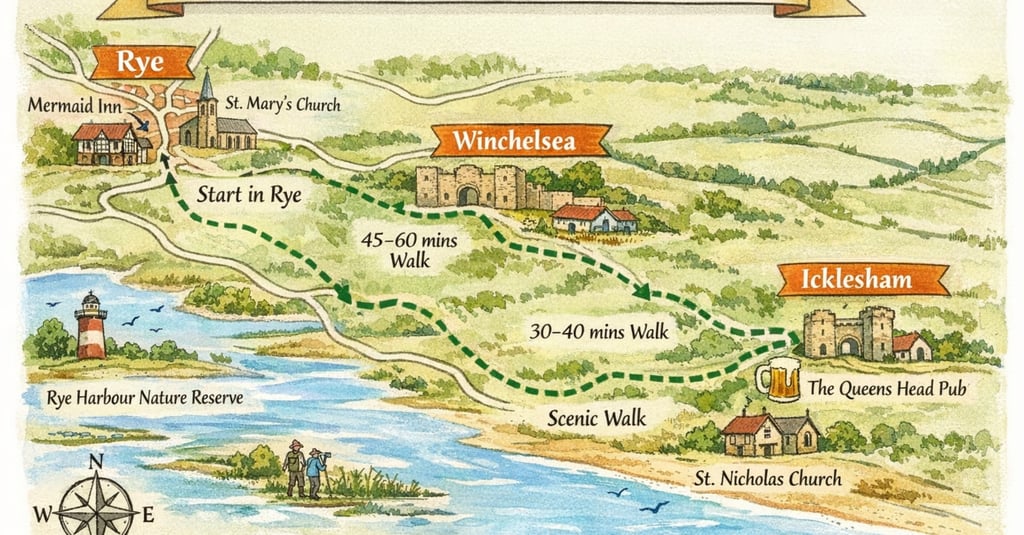
Rye/Winchelsea/Icklesham Walk/Bike Ride
Start: Rye town center
Highlights in Rye:
Cobbled streets, the Mermaid Inn, St Mary’s Church.
Quick coffeeat a local café before setting off.
Step 1: Rye → Winchelsea (~2–3 miles / 45–60 min walk, or 5–7 min drive) or 15 by bike
Route: Follow the road along the edge of Rye Harbour Nature Reserve for scenic marsh views.
Stop in Winchelsea:
New Inn – grab a pint or light snack.
Explore the medieval gates and St Thomas the Martyr Church.
Optional: Short detour to Winchelsea Beach if the tide and weather are good.
Step 2: Winchelsea → Icklesham (~1.5–2 miles / 30–40 min walk)
Route: Cross the Romney Marsh countryside via quiet lanes and footpaths. Lovely rolling fields, farmland, and occasional views of the coast.
Stop in Icklesham:
Queens Head Pub – perfect for lunch or another drink.
Wander around the village church and local lanes.
Step 3: Icklesham → Rye (~3 miles / 1 hour walk or 8 min drive)
Route: Loop back along minor roads and footpaths cutting across farmland. You’ll pass hedgerows, small streams, and classic East Sussex countryside scenery.
Cycle Routes
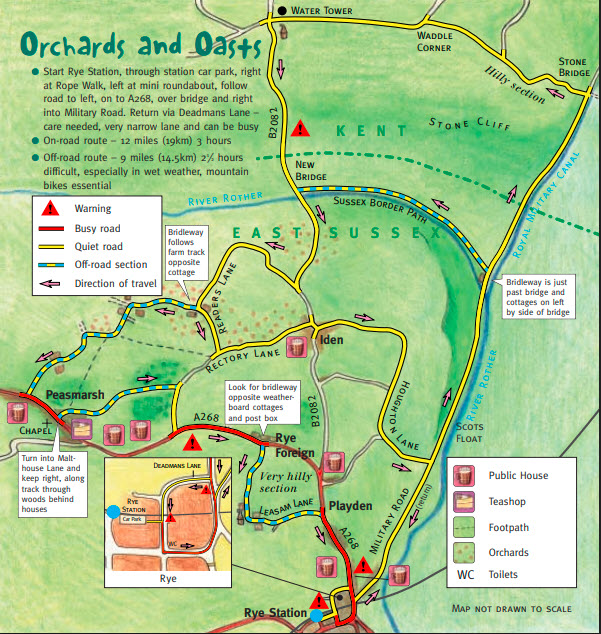
Orchards And Oasts
On ROAD: Along the Royal Military Road which follows the route of the Royal Military Canal, a quick steep climb up the old sea cliff and into the undulating High Weald of oast houses and orchards, through the beautiful village of Iden and back into Rye. (Return to the station via concerning named Deadmans Lane – caution required, very narrow lane and can be busy at times).
OFF-ROAD - Along the Royal Military Road then following the River Rother to New Bridge and Iden. Past oast houses and orchards, through woods and along tracks into the village of Peasmarsh. This route is challenging and suited primarily to the enthusiast!
Suitability: This is described as a challenging route primarily suited for enthusiastic cyclists, likely best for mountain bikes or gravel bikes due to off-road sections and elevation changes.
There are many oast houses to be found in this part of East Sussex and Kent, reflecting the former importance of the brewing industry in the area. Most of the oasts which you see today are converted to private homes, but were once used as kilns for drying hops which had been grown on the farm. These were delivered to the nearest brewery, and the beer would have been drunk locally. Oast Houses Hops have been a well known feature of the Kent and East Sussex countryside since they were introduced from the Low Countries at the end of the 15th century.
Traditional tall tree orchards interspersed with poplar windbreaks can still be seen in this area, but these are now largely being replaced with closer packed bush varieties which are easier to manage. Locally produced apple juice is a must to try and can be found in many of the shops in the area.
Places to stop:
Rumples Inn and Restaurant, Peasmarsh Road, Rye Foreign
The Cock Horse Inn, Main Street, Peasmarsh •
Cornerways Teashop, Main Street, Peasmarsh •
Hare and Hounds, Main Street, Peasmarsh •
Playden Oast Hotel, Playden
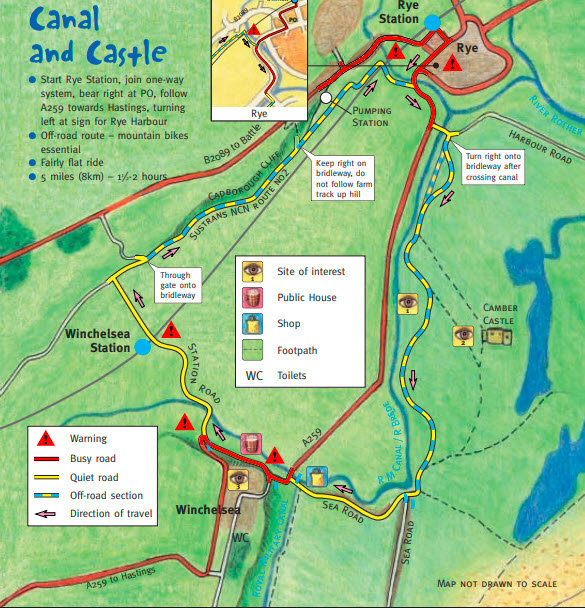
Castle and Canal Route
The Canel is the Royal Military Canal built between 1804 and 1809 and runs for 28 miles from Pett Level to Hythe. It is made up of two sections linked together by the rivers Rother and Brede and was designed to act as a canal and fortification against Napoleon’s threat of invasion. This canal has now become very important for fishing (permits required) and many other forms of wildlife. In summer watch out for emperor dragonflies, reed warblers and the noisy marsh frog. Mute swans and kingfishers can be seen all year. The castle in the route was built in 1539 by Henry VIII as an artillery fortress, with rounded towers to deflect cannon-shot. It is one of a chain of similar coastal fortifications which stretch from East Anglia to South Wales, the cost of which drained Henry’s treasury. These drastic measures were felt necessary as, due to Henry’s religious reformations, he faced powerful enemies, including the Holy Roman Emperor and the Pope. However, within 100 years the sea retreated, as did the threat of war, leaving the castle redundant.
Rye Harbour and Nature Reserve
Rye Harbour Nature Reserve is one of the best places to stretch your legs and soak up some nature. Run by the Sussex Wildlife Trust, it’s considered the jewel in the crown of their reserves. It’s a true wildlife hotspot, with over 280 bird species recorded, including the striking Avocets, often seen nesting in the lagoons and mudflats. Flat, accessible trails wind through saltmarsh, shingle, and wetlands, leading out to the sea. It’s about a one-mile walk to the beach from the main car park, with huge skies and wide views all the way. It is about 1.5 miles from the house. Website for the Nature Reserve is: https://rye.sussexwildlifetrust.org.uk/
If you hire bikes locally in Rye Harbour, you can follow the trail along the seafront, through the reserve, and all the way to Pett Level – a brilliant coastal ride packed with birdlife, sea air, and wide-open views. At ett Level there is a pub (The Smuggler) and there is the Royal Oak in Pett. If you want to walk, its about 2.5 hours but there is a bus (101) that goes from Pett Level to and from Rye. Buses are operated by Stagecoach.co,uk

Rye to Camber Sands Beach
A scenic flat route mostly on a path from Rye citadel to Camber Sands Beach. Its about 4 miles and there is a hourly bus (Route 100). Its walkable or bike able.https://tinyurl.com/RyetoCamberCyclepath
Peasmarsh Walk
A 4-mile easy circular walk, from the village of Peasmarsh through woodland and across fields to the earthwork remains of Iden Moat. map https://www.eastsussex.gov.uk/media/cwxdodwf/peasmarsh-walk.pdf
Beckley Walk
A 3-mile generally easy walk with stiles and some potentially muddy paths, starting from Beckley Village.
Royal Military Canal Path
The path runs for 28 miles along the entire length of the Royal Military Canal from Seabrook in Kent to Cliff End in East Sussex, linking with many footpaths along the way. More info.
1066 Country Walk
Follow the steps of William the Conqueror on this 31 mile trail, from the Normans’ landing point at Pevensey to the battlefield, through to the ancient towns of Winchelsea and Rye, taking in castles, oast houses and windmills along the way. In 2021, new signage and sculptures were installed.
Rye → Peasmarsh / Northfields Farm Circular
Distance: ~4 miles (6.5 km). Head north from Rye to Peasmarsh, looping across working sheep farms and open fields, then back along quiet lanes. This covers active farms with sheep grazing, classic Sussex Hedgerows and small villages
Websites
Tourist Guide for the Sussex Weald including Rye including walks, What's On, Maps etc
Hotel website that promotes local activities
Town Tourist Office
annterrygo@gmail.com
+1978-270-3355
© 2025. All rights reserved.